Global trends of the logistics industry in 2026

The logistics industry at the start of 2026
As we enter 2026, the global logistics domain is more complex and dynamic than ever before. According to the World Bank, the global economy is expected to grow by 2.7% in 2026 as inflation and interest rates gradually decline. As supply chains continue to recover from disruptions earlier in the decade, the logistics industry is focusing more on adaptability, resilience, and the ability to anticipate changes in global logistics market trends rather than simply reacting to them.
Key forces modifying global logistics in 2026
The logistics industry trends 2026 are being determined by several converging macroeconomic and transnational political conditions:
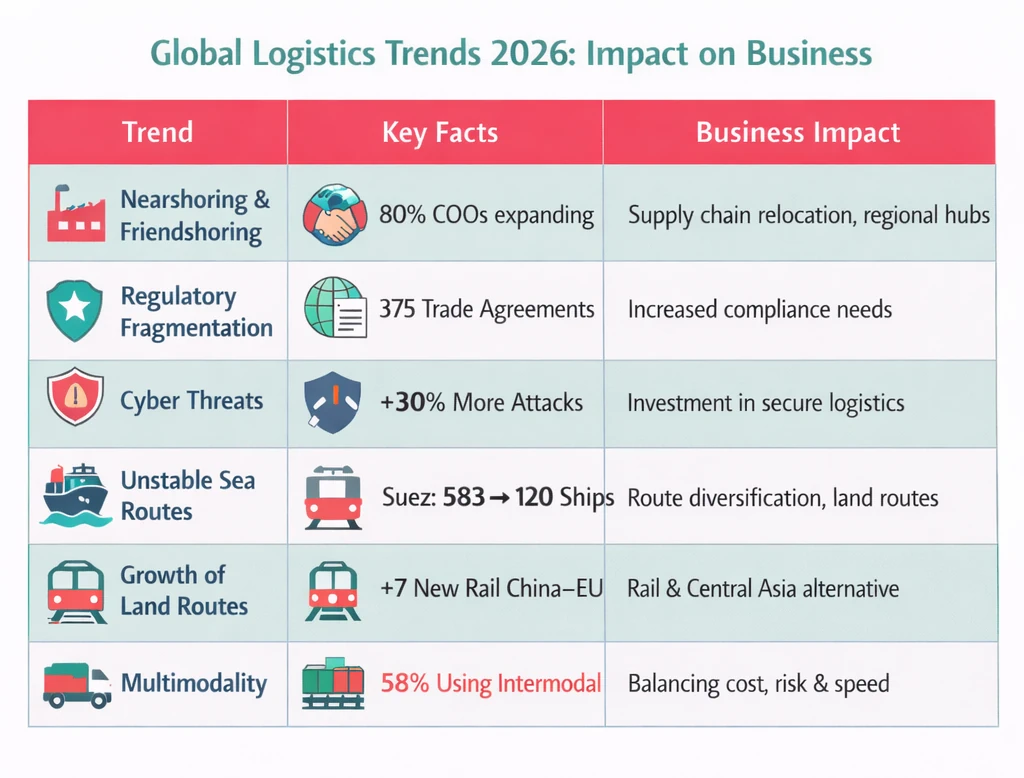
- The acceleration of nearshoring and friendshoring. According to Bain, 80% of COOs plan to increase onshoring/nearshoring over the next three years.
- Regulatory fragmentation, with 375 regional trade agreements currently in force worldwide. Goods moving across borders encounter a complex and fragmented patchwork of rules, requiring global logistics solutions to be more agile and compliant.
- Increasing call for secure global logistics in response to cyber threats and physical disruptions. Supply chain cyberattacks in 2025 are occurring at nearly double the historical rate, and nearly 30 % of business leaders report increases in supply chain cyberattacks.
- Volatility in fuel and energy prices impacts global logistics services and the calculation of landed costs.
Global trade routes under transformation
Shift away from single-corridor dependency
One of the most significant logistics trends for 2026 is a definitive shift away from dependence on a sole major trade corridor. The 2021–2024 Suez Canal and Panama Canal disruptions served as wake-up calls. Experts highlighted that, in November 2025, only about 120 container ships transited the Suez Canal — down sharply from roughly 583 in October 2023. In response, global logistics and supply chain management strategies now focus on building redundancy into routing options. Maritime transportation logistics now rely on longer, yet more stable routes and testing new connections.
Growth of regional and cross-regional routes
While Asia – Europe and Trans-Pacific lanes maintain their importance, there is remarkable growth in South: South and intra-Asia trade. For example, the Asia–Africa trade lane grew by 27.3% in 2025, while trade between China and ASEAN grew by 9.4% year-on-year in the first seven months of 2025. Express global logistics providers are pouring considerable investment into these emerging lanes, both to capitalize on new markets and to hedge against long-haul disruptions.
Increased role of land-based transit corridors
The development and utilization of land-based routes — including the Trans-Asian Railway and new Central Asian corridors — have accelerated. At the very end of 2025, 7 new rail freight routes from China to Europe were introduced into the timetable, resulting in more than 1,000 additional freight train movements. Investments in infrastructure and cross-border facilitation are making these corridors critical elements of global critical logistics and global logistics solutions. Road transportation gets back to the picture too as a safer option, unfolding in the improving international land routing landscape.
How logistics operations are being redefined
Reliability overtaking speed as a priority
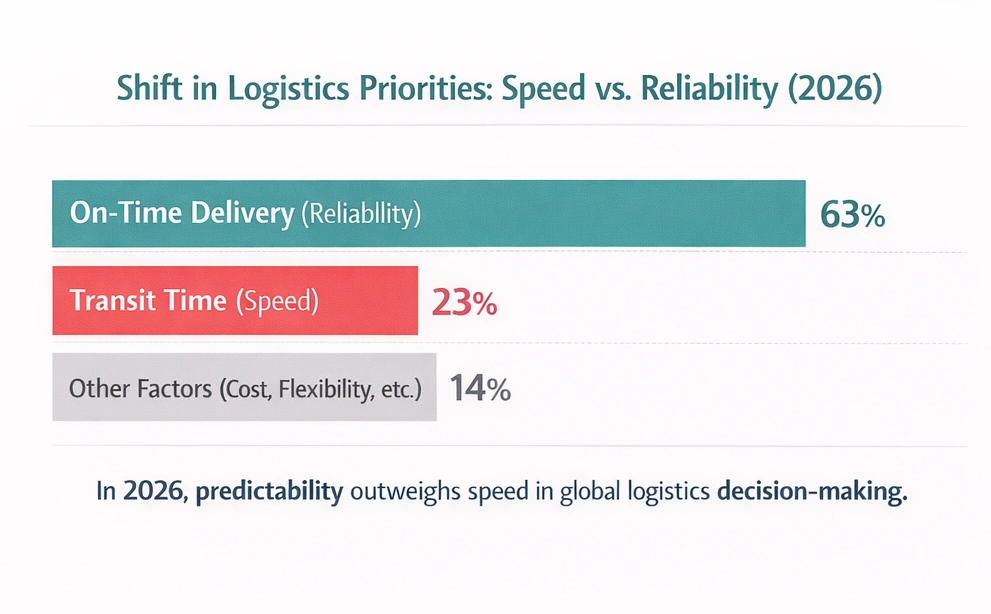
In 2026, reliability is regularly preferred over sheer speed. A recent survey by Kuehne+Nagel found that logistics managers overwhelmingly prioritize on-time delivery (63%), significantly more than speed (23% for transit time). This reveals an evolution in global logistics company strategies, with greater emphasis on resilient, predictable service — especially for premium or time-sensitive cargo. Without a profound warehouse management and network, this top-tier service is unattainable with transport logistics alone.
More selective use of transport modes
The volatility of ocean and air freight rates has led to a more sophisticated allocation of transport modes. Shippers are increasingly favoring multimodal or intermodal solutions that balance costs, speed, and risk. For example, nearly 58% of logistics operators now use intermodal methods that combine rail, road, and sea transport.
Stronger focus on route and partner diversification
The lesson from recent years: overdependence on a single logistics provider or route is a liability. In 2025, the share of shippers consolidating the number of 3PL partners they use fell to about 57% (from 78% previously). The growth of digital freight marketplaces is also supporting this shift, making it easier for businesses to access a wider range of global logistics services and to monitor performance in real time.
What these logistics trends mean for businesses in 2026
For shippers, freight forwarders, and 3PLs, the current trends in the logistics industry present a mix of challenges and opportunities:
- Network design and contingency planning are now board-level priorities. Businesses are applying advanced analytics to simulate disruption scenarios and optimize routing for resilience as much as cost.
- Partner selection is more rigorous, with security, compliance, and real-time visibility as minimum requirements for secure global logistics.
- Sustainability pressures are intensifying, with the European Green Deal aiming to attain climate neutrality in the region by 2050.
- Digitalization is advancing past visibility tools to include advanced predictive analytics, risk management platforms, and blockchain-based document flows. While AI trends in the logistics industry in 2026 are important, the competitive edge lies in tangible, operational applications rather than general automation.
SYNEX Logistics at the vanguard of global logistics in 2026
As an industry leader in global logistics and fulfillment, SYNEX Logistics has proactively adapted to the latest trends in the logistics industry. This includes:
- Expanding our network of alternative and regional trade lanes, providing unbroken global logistics solutions even during major corridor disruptions.
- In this instance we are introducing a dedicated rail solution via the Middle Corridor (Caspian route) for Europe–Central Asia trade, offering a cost-efficient land alternative to long-haul road transport and a sanctions-compliant option for European companies unable to route cargo through Russia.
- Channeling funds into state-of-the-art risk management technologies and synergistic technology platforms, supporting both global logistics management and security for high-value shipments.
- Offering modular global logistics services—from express to multimodal—tailored to developing customer needs.
- Partnering with infrastructure developers to strengthen land-based transit corridors, augmenting our role as a trusted global logistics company.

Contact SYNEX Logistics for a clear quote, freight-forwarding planning, and support from the point of departure to the point of destination, with utmost precision in documentation and legal work. We offer transportation without borders.
Conclusion
The trends in the logistics industry in 2026 are defined by adaptability, resilience, and a preemptive mindset to risk and opportunity. The companies that thrive will be those that build multi-layered networks, embrace regional and multimodal flexibility, and align their operations with the shifting realities of current trends in logistics and supply chain management. At SYNEX Logistics, we remain committed to being at the cutting edge of these developments, supplying resilient, responsive, and secure global logistics solutions for a dynamic global context.