The TRIPP Is Starting: New Logistical Opportunities in the Middle Corridor
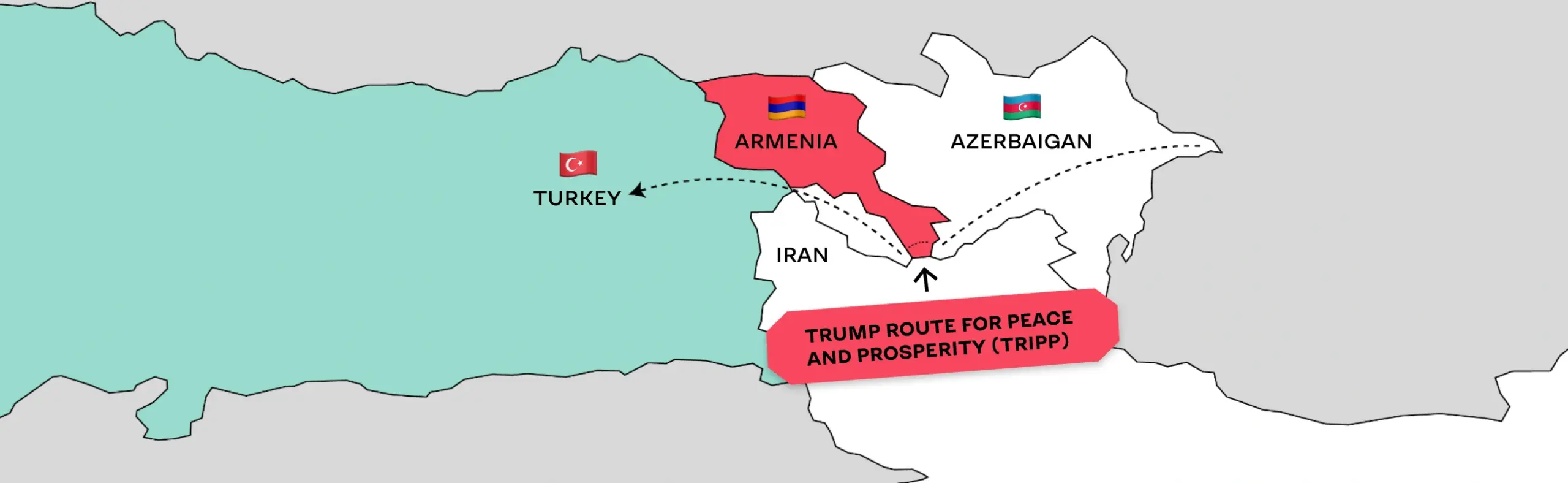
The construction of Trump Route for International Peace and Prosperity (TRIPP) is scheduled to open in the second half of 2026, marking the next phase in formalising the Zangezur corridor within the broader Middle Corridor framework. Although full operation will follow later, the project is already shaping long-term logistics route planning between Asia and Europe. What does this mean for international businesses and logistics companies preparing future cargo flows? As an established 3PL operator successfully connecting China with Europe through the Caspian region, SYNEX Logistics is ready to share its perspective on how TRIPP may influence route development, transit strategy, and the evolving structure of the middle corridor trade route.
What is the TRIPP route, and how does it fit into the Middle Corridor
TRIPP is planned to be built around reopening the rail link between mainland Azerbaijan and its Nakhchivan exclave through Armenia’s Syunik region — a segment that historically functioned but remained inactive for decades. The planned infrastructure follows the former Soviet railway alignment and is designed to operate alongside parallel energy lines, including a gas pipeline and a power transmission corridor. A road component is still under discussion, but rail remains the backbone of the project.
Politically, the project operates within Armenia’s «Crossroads of Peace» framework. Armenia maintains full sovereignty over the territory, while American contractors may participate in elements of management or security coordination. On the Azerbaijani side, the Horadiz–Agbend railway segment is advancing toward completion, positioning the route for physical connection once the Armenian section proceeds. From a logistics standpoint, this configuration transforms the Zangezur corridor from a diplomatic concept into an operational element of the Middle Corridor trade route.
How the Zangezur Corridor enables a new Eurasian land bridge
Within the broader middle corridor architecture, the Zangezur corridor addresses a structural discontinuity in the South Caucasus segment. The Middle Corridor already links China, Central Asia, the Caspian Sea, Azerbaijan, Turkey, and onward to Europe through a rail–sea–rail configuration. By restoring direct rail continuity between mainland Azerbaijan and Nakhchivan through Armenia’s Syunik region, this segment re-establishes a missing terrestrial connection inside the Eurasian transit chain. The result is not the creation of a new route, but the consolidation of an existing one into a more continuous land-based system.
In practical structural terms, this corridor:
- Reconnects two separated rail systems — Azerbaijan’s main network and the Nakhchivan segment, which links further toward Turkey.
- Restores a historically existing alignment — using the former Soviet railway corridor rather than developing an entirely new geographic path.
- Integrates energy and transport infrastructure — combining rail reconstruction with planned gas and power transmission lines along the same axis.
- Creates physical continuity across the South Caucasus — replacing indirect routing arrangements with a direct land passage.
- Formalizes the corridor within an institutional framework (TRIPP) — embedding the infrastructure inside an internationally mediated structure rather than leaving it as a bilateral transport arrangement.
Continuous tilt toward land-based routing is one of the main logistic trends of 2026. And the TRIPP is being the one of the most prominent examples supporting it.
What makes the TRIPP route structurally viable
Legal framework and the Zangezur Corridor agreement
The route’s viability—especially for ambitious projects like TRIPP—rests on a strong legal foundation. The TRIPP Implementation Framework (TIF) sets out clear transit rules, customs harmonization, and dispute resolution mechanisms. These legal instruments ensure that logistics route planning and route optimization in logistics are grounded in predictable, enforceable regulations, lowering risks for investors and operators seeking fast and efficient cargo movement.
International guarantees and political risk safeguards
International political guarantees underpin the unbroken operation of transit projects such as TRIPP. The governments of Armenia, Azerbaijan, and Turkey, with support from regional organizations, have committed to defending transit rights along with ensuring non-discriminatory access. And the U.S. is one of the biggest guarantors, with its company set to manage the route for at least 45 years. These safeguards reduce the risk of sudden border closures or regulatory changes—a regular concern for logistics route planners across the middle corridor in central Asia—and give TRIPP its unique resilience.
Infrastructure readiness across Armenia, Azerbaijan and Turkey
What distinguishes TRIPP on a practical level is its infrastructure readiness—an incessant challenge in Eurasian logistics. Armenia’s renewed Yerevan–Zangezur rail link will cut transit times drastically, while Azerbaijan’s investments in Turkey’s Kars hub have created a network where cargo moves with minimal friction. This orchestration of multimodal handoffs, supported by live tracking and customs harmonization, is how the region is setting a new bar for logistics routing standards, offering clients predictive delivery schedules and measurable reliability gains.
Coordination with the Central Asia Middle Corridor strategy
Integration in conjunction with broader Middle Corridor initiative efforts is a defining feature of the TRIPP route. By connecting to Kazakhstan’s rail network and China’s Belt and Road infrastructure, TRIPP offers a direct path to European markets and supports the entire corridor’s connectivity. Its interoperability with existing Central Asian logistic route planner platforms permits businesses to diversify supply chains, refine route planning logistics, and cut reliance on single corridors.

Strategic advantages for Asia–Europe cargo flows
Shorter transit cycles within the Middle Corridor trade route
The integration of TRIPP into the middle corridor trade route is expected to shorten transit cycles across the South Caucasus segment. Compared to the traditional Baku–Tbilisi–Kars railway alignment through Georgia, routing through the Zangezur corridor could reduce transit time by up to 25%. For end-to-end shipments moving from China to Europe via the Middle Corridor, total delivery time is projected to decrease from approximately 18 days to around 14 days once the route becomes operational. On the specific stretch between mainland Azerbaijan and Nakhchivan, direct rail continuity may save close to one full day compared to the Georgian alignment, tightening scheduling windows across the broader Eurasian land bridge.
Diversified routing beyond traditional corridors
Diversified routing, made possible by TRIPP’s strategic pathway, allows operators to bypass congested or politically sensitive areas such as the Russian borderlands or the Suez Canal. Such flexibility empowers logistics route planners to customise solutions for varied cargo types and risk profiles. For example, high-value electronics and automotive components can be shipped with greater predictability, avoiding maritime delays and customs bottlenecks—a key benefit emphasized in recent middle corridor updates from regional authorities.
Improved supply chain security and continuity
Risk management is integrated into the TRIPP concept. With uninterrupted monitoring, digital customs clearance, and comprehensive cargo insurance, the corridor lessens the impact of regional volatility and supply chain shocks. These measures are not simply technical upgrades—they change the calculus for manufacturers and retailers who depend on continuity. As a result, TRIPP distinguishes itself among all route logistics, yielding security as well as strategic advantage in an unstable world.
New positioning for investors and regional hubs
For investors, the TRIPP-enabled corridor is already yielding tangible opportunities. Yerevan, Ganja, and Kars are being transformed into next-generation logistics nodes, each attracting not just warehousing and value-added services, but also new layers of financial and digital infrastructure. The region’s logistics sector, according to the middle corridor initiative report, is set for sustained compound annual growth—exceeding $2.5 billion in new infrastructure investment by 2030—and these hubs are positioned to anchor a new geography of trade, innovation, and regional cooperation.
How SYNEX Logistics plans to structure transportation via TRIPP
SYNEX Logistics is monitoring the development of TRIPP at the infrastructure and regulatory level to assess how it can be incorporated into future routing scenarios. At this stage, our focus is on evaluating projected rail alignment, border processing design, expected transit windows, and the interface with existing Azerbaijani and Turkish networks.
Rather than prematurely embedding the corridor into active routing, we are conducting feasibility modeling and scenario planning. This includes comparative distance analysis against current South Caucasus alignments, projected handling times, and preliminary capacity assumptions. If TRIPP moves into full transit operation, we are prepared to negotiate rail capacity allocations, establish transport logistics with local operators, adjust multimodal handover points, and integrate the corridor into client-specific routing matrices.
In parallel, we are ready to update insurance structures, customs brokerage workflows, and contingency routing protocols to reflect the new configuration. Contact us for long-term international and intercontinental logistics cooperation and partnership. The objective is controlled activation — incorporating the corridor into live supply chains only once operational reliability, regulatory clarity, and throughput performance meet commercial standards.
Conclusion
The TRIPP route is changing the landscape for logistics route planning and logistics route optimization between Asia and Europe. Via harnessing the strengths of the middle corridor and the Zangezur corridor, this project delivers unprecedented speed, safety, and international guarantees key for modern supply chains. Businesses and investors now have access to a structurally viable, diversified logistics route, supported under robust regulatory systems and world-class infrastructure. As SYNEX Logistics and other industry leaders embrace TRIPP and the wider middle corridor project, the Eurasian land bridge moves from geopolitical vision to a reliable, future-proof solution for global cargo flows.