Maritime logistics in Ukraine: realities
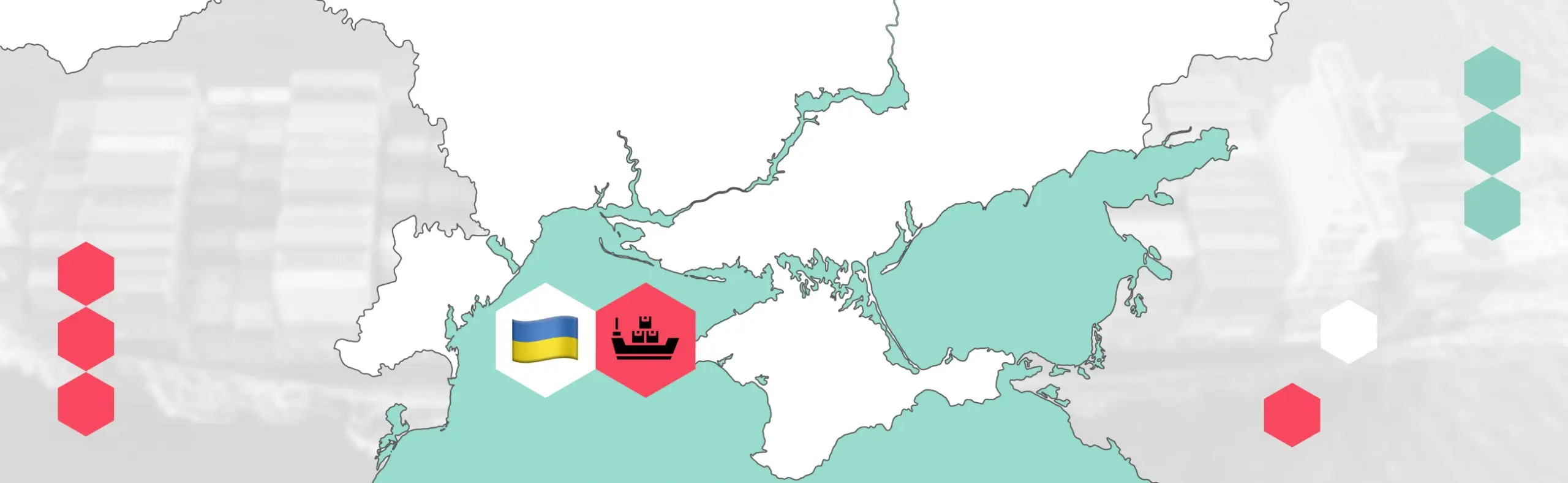
Ukraine has a well-developed agricultural and metallurgical sector and is located at the crossroads of trade routes between Europe, Asia, and the Middle East. Maritime logistics accounts for a significant share of the country’s economy. However, Russia’s full-scale war against Ukraine has forced a reconsideration of the role and functioning of this system. In this article, we will examine how Ukrainian business is adapting to the new conditions and which logistics solutions are helping preserve exports during the war. We will analyze the role maritime logistics plays in the economy, the constraints it faces, and the alternative routes currently being used.
Contents:
- What role does maritime logistics play for Ukrainian business today?
- How has the structure of maritime transport changed since 2022?
- Key constraints facing maritime logistics in Ukraine
- Alternative routes and new entry points for maritime logistics in Ukraine
- SYNEX Logistics’ approach to maritime transport in Ukraine
- Conclusion
What role does maritime logistics play for Ukrainian business today?
Ukrainian maritime routes are part of global trade networks. Through Black Sea ports, grain, vegetable oil, ore, and metal products are exported to EU countries, South Asia, and the Middle East. In peacetime, Ukraine’s seaports formed the backbone of international trade, with more than 90% of agricultural export volumes being shipped through them.
Even during the war, maritime routes remain critically important:
- In 2025, the cargo turnover of seaports amounted to 82.2 million tons, which is approximately 95% of the planned volume.
- The export of grain, oil, metals, and other products remains an important source of foreign currency revenues for the economy.
- Maritime cargo transportation makes it possible to move large volumes of goods over long distances in a cost-effective way, remaining a key channel for Ukrainian exports.
- Ukrainian companies invest in shipping routes to ensure greater predictability of deliveries even under high-risk conditions.
In fact, maritime logistics today is a major resource for Ukraine’s national economy and trade independence.
How has the structure of maritime transport changed since 2022?
The full-scale war drastically changed Ukrainian maritime logistics. Immediately after the invasion, some traditional routes were halted: the ports of the Azov Sea, including Mariupol, were lost, while others were blocked or damaged. In the first months of the war, shipping volumes decreased significantly, forcing businesses to rapidly restructure their logistics chains.
This led to the creation of the Ukrainian maritime corridor, which made it possible to restore vessel departures from the ports of Greater Odesa and gradually reintegrate Ukrainian maritime routes into global trade flows.
At the same time, the structure of transportation also changed: part of the cargo flow was redirected through Danube ports, river logistics, and rail routes to European ports. However, thanks to the adaptation of logistics operators and the support of international partners, maritime corridors continue to function, allowing Ukrainian business to remain part of global trade even under wartime conditions.
Key constraints facing maritime logistics in Ukraine
Although Ukraine is gradually restoring international maritime transportation, logistics still operates under constant restrictions. Beyond routes themselves, the war has changed the very logic of how ports, shipping companies, and exporters operate. Every stage, from voyage planning to cargo insurance, is accompanied by additional risks, costs, and operational challenges. Let us look at them in more detail.
Security factors and the impact of military risks
The biggest risk for shipping remains the security situation in the Black Sea. Some ports under Ukrainian control are regularly targeted by missile and drone attacks, and there is a real threat from mines in open waters. All of this requires careful planning of routes, vessel arrival windows, and transshipment logistics. Even after the launch of the maritime corridor, shipping continues to operate with wartime risks in mind: depending on the situation, vessel routes are adjusted, safety requirements are tightened, and each voyage is additionally coordinated among ports, carriers, and government and military authorities.
Cargo insurance and additional costs
Insurance for vessels and cargo in high-risk areas has become significantly more expensive, as insurers build the risks of shelling, mined waters, and possible infrastructure damage into their rates. War risks are not covered by standard marine insurance policies, so shipowners are required to obtain additional war risk insurance (EWRI) before entering Ukrainian ports.
Despite this, maritime logistics still remains economically viable for international transportation of large consignments, although its cost has increased noticeably. The launch of the international Unity insurance program in 2023, with the participation of the Government of Ukraine, Lloyd’s, and Marsh McLennan partially helped stabilize transport insurance and make it more accessible for non-military cargo.
Limited capacity of port infrastructure
This is another limiting factor, as part of the port infrastructure was damaged during attacks, while some logistics hubs are currently inaccessible due to occupation. In addition, because of security restrictions, ports are not operating at full capacity, and shipping often depends on agreed movement schedules. As a result, cargo handling queues arise, and companies are forced to plan logistics in advance in order to avoid delays. In these circumstances, Ukraine’s maritime logistics operate under significantly greater strain than in the pre-war period. Nevertheless, even with these constraints, it remains a key export channel for Ukrainian business and an important element of the country’s economic resilience.
Alternative routes and new entry points for maritime logistics in Ukraine
When traditional Black Sea routes were threatened or blocked, businesses promptly shifted to alternative entry points in maritime logistics – primarily the Danube cluster and European ports. This effectively created a new transportation model in which maritime and land routes work in close combination.
The Danube cluster and its real role
In 2022, the role of the Danube ports, Izmail, Reni, and Ust-Dunaisk, grew sharply. They became the main backup export channels. For example, in March 2023, Maersk announced the official launch of a new container service providing a direct delivery route to Ukraine via the port of Reni. In the same year, transshipment volumes in the Danube cluster effectively doubled to 32 million tons of cargo. For Ukrainian business, these ports became a kind of “logistics island of safety,” allowing it to partially offset the blockade of major Black Sea ports and continue actively exporting goods to countries importing from Ukraine.
At the same time, it is important to understand that while Danube ports are vital, they cannot fully replace the large deep-water ports of the Black Sea. Their capacity is limited by channel depths, infrastructure, and more complex transshipment logistics.
Working through European ports as part of the maritime chain
Another solution has been the use of EU ports as an extension of Ukraine’s maritime logistics. Cargo is transported by rail or river to ports in Romania, Poland, or the Baltic region, from where it is shipped by sea to final markets.
The Romanian port of Constanța has become especially important, turning into one of the main transit hubs for Ukrainian grain. Thanks to this, Ukrainian companies remain part of global trade chains even when the operation of their own ports is restricted.
Combining maritime and land sections of the route
To reduce dependence on a single route, exporters are actively combining land and maritime segments. Part of the route is covered by road or rail transport to Danube or European ports, after which the cargo continues by sea. Such multimodal solutions are more complex and more expensive than the pre-war model of direct maritime transportation, but they make it possible to sustain exports even under unstable conditions.
In fact, the war has forced Ukrainian logistics to become more flexible. Today it does not rely on a single route, but on a network of alternative directions, and this diversification has become one of the key factors of Ukrainian export resilience.
SYNEX Logistics’ approach to maritime transport in Ukraine
In wartime conditions, maritime logistics in Ukraine requires thoughtful risk management and flexible routing. This is exactly the approach applied by SYNEX Logistics. As a 3PL operator, the company effectively combines maritime freight transportation with road or rail delivery through European ports. This makes it possible to build more resilient supply chains and quickly adapt routes depending on the situation in the region, port availability, and geopolitical risks.
Risk management and transport insurance are equally important. Our team provides freight forwarder liability insurance, cargo support, and customs brokerage services at every stage of the route, which is especially critical under the current unstable security situation in the Black Sea region. Thanks to this approach, Ukrainian business can remain part of global trade chains by ensuring flexible maritime routes, risk control, and predictability of international deliveries.
If you are planning maritime transportation, contact SYNEX Logistics and secure your cargo with a reliable, flexible, and predictable route even in complex geopolitical conditions.
Conclusion
The full-scale war has become a serious challenge for Ukrainian maritime logistics, but at the same time it has demonstrated its ability to adapt quickly to new conditions. Thanks to the development of alternative routes, multimodal transportation, and cooperation with international partners, Ukrainian business continues to have access to global markets even amid heightened security risks. This flexibility and ingenuity are shaping a new standard of Ukrainian exports, one that is not stopped by either constraints or risks.